According to the package of documents that I received at the door, ‘Articululate’ is a portmanteau of the words ‘articulate’ and ‘ululate’ – the latter term meaning a howl or wail expressing extraordinary grief.
The symposium was supported by both NCAD and GradCAM, and was organised by ‘No-How’, a PhD seminar group whose members include Ruby Wallis, Sinead McCann, Alison Pilkington and Naomi Sex. Articululate also featured invited contributions from Kevin Atherton, Gary Coyle, Amanda Coogan, Philip Napier and Sally O’Reilly.
Many people arrived late, no doubt owing to Google Maps placing Newman House on the opposite side of St Stephen’s Green. The building itself is part of the UCD campus, and dates back to the 18th century. Its windows are at least twenty feet tall. Kevin Atherton took to the podium to introduce the event, and briefly discussed the symposium’s theme of presenting artistic research methods that are in themselves a form of research activity.
The first speaker of the day was Gary Coyle, who presented a version of his performance work At Sea, based on a series of tales taken from his decade of daily swims at the Forty Foot in Sandycove, Dublin. Coyle spoke in the style of a theatre actor, fluid and without notes. In ten years, he has meticulously documented his swimming ritual in notebooks, drawings and over 10,000 photographs. He also collects stories, each taken from an interesting day here and there; these focus squarely on the characters who frequent the local area and cross his path, and his enjoyment comes from recalling their quirks and his run-ins with them. For example: “I cycled down towards Sandycove, the police are there in force, stopping people, checking their bags, trying to prevent the riots of yesterday. They don’t seem to be having much of an effect. Everywhere you look, people are drinking. It’s like some vast 18th century fair as depicted by Hogarth. As I’m outside the Forty Foot, bent over, fumbling with the lock of my bike, I receive the most unmerciful kick up the crack of my arse. I whirl around to confront my assailant, to be greeted by a very drunk, overweight 14-year-old girl. She just laughs straight in my face and says ‘oh sorry! I thought you were someone else.’”
In contrast to Coyle’s hour-long theatrical presentation, Alison Pilkington presented her practice-based research in seemingly straightforward ten-minute artists talk. Pilkington has developed a painting practice heavily rooted in the uncanny, exploring paradoxical feelings of both familiarity and upset – and overall the experience of being unsettled. Pilkington frequently uses actual mirrors or mirroring techniques to offer audiences a sensation of this uncanny experience. By way of demonstration the artist presented a series of slides, which ended with an image of the room we were sitting in, seen from her perspective – but empty, save for a painting hung near the entrance at the back for room. As if by reflex, the audience turned around to see this painting, which of course was no longer there.
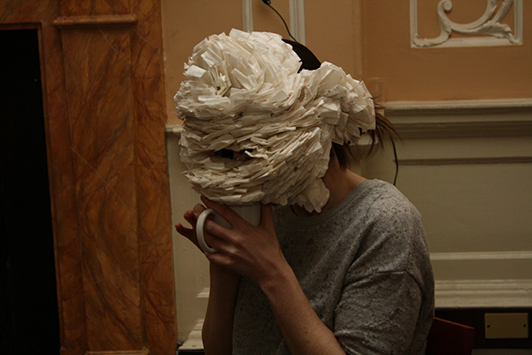
After a short break, the audience moved to a downstairs room where Sinead McCann had prepared for a brief performance. A female actor sat at a glass table in front of a boiling kettle, with the audience seated in a semicircle around her. Her head was covered in a frilled ball of what looked to be white tissue paper. The room was dark, save for a few red lights to outline her presence at the table. She spoke solemnly about feelings of dislocation and strain that come living on social welfare; this set of recollections was apparently gathered from interviews and field research. After her story ended, McCann and an unidentified performer sang without accompaniment in a turn of the century blues style, their lyrics revolving on the refrain “walk slowly”.
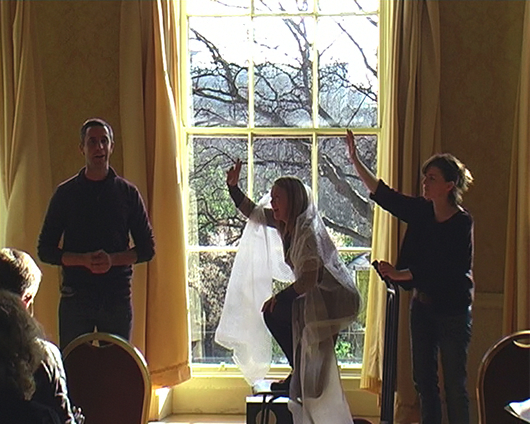
Back in the main symposium room, Naomi Sex delivered her presentation with two actors, Darina Gallagher and Dave Layde. During the summer of 2010, Sex and four other artists had attempted to negotiate their way into exhibiting as part of the well-known amateur exhibitions that are frequently visible on the railings of St. Stephen’s Green. These exhibitions are organised by a committee, who imposed a plethora of rules before allowing the artists to exhibit unframed works, installations, or artworks without a visible price tag. The audience received a page of Naomi Sex’s prepared remarks in advance.
Her text included notations dotted throughout to signify where her hand gestures and verbal tics would normally occur. The three performers stood in a single file as they begun, and moved into different positions throughout the presentation, each taking turns at delivering part of the prepared remarks. Every time a verbal tic such as “eh” appeared in the text, all three announced it loudly. When the text denoted a physical manoeuvre such as “two hands spread out gesture” or “holding two melons hand gesture”, the group acted these out as though they were synchronised swimmers.
The act lasted for no longer than ten minutes. Naomi Sex concluded on a point about how the structures preventing the public exhibition of installation or unframed work constitutes a particular filtration system, within a ‘reputational economy’.
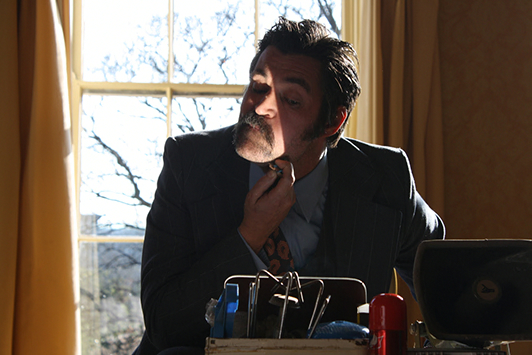
The next speaker was Philip Napier, Head of Fine Art at NCAD. A small table and chair sat in the centre of the room, covered in an assortment of bottles, machines and packages. Napier, dressed in an antique suit, strode across the room and flicked a switch on one of the machines; it emitted a loud sound similar to a transistor radio. He then poured himself a glass of whiskey, and said, “the thing about this kind of event is how to get started, and knowing how to finish, so I thought I’d start with a bit of Old Spice.” He picked up a bottle from his table and passed it around the room, with the instructions that each person should rub the aftershave into their upper lip. Then he sat down and began talking.
He spent a few minutes telling a story of living in Dromore, Co. Antrim during the troubles in the 1970s. I was struck by his description of a man who had been asked to identify a body, and whose hair had turned white in the months following. Napier had bought a suit from the era in the second-hand shop before the performance, and mentioned his shock at having spent £50 on making an artwork. At this point, he picked up a razor from the table and began to shave his beard.
Napier had somehow wired his razor into the transistor radio, and what had previously sounded like static became a dull ripping sound as the blade tore across his face. He continued to talk while shaving and a number of small cuts began to appear around his neck, he blotted them with small pieces of tissue. He stopped, and sat back in his chair for a few minutes, and after further storytelling, began to shave again. This time the blood had escaped from the small cuts, and by shaving, Napier spread a thin layer of blood across his neck and face. He stood up and insisted that the crowd pass the Old Spice amongst themselves once more, apparently to ensure that the assembled listeners had properly applied the aftershave beneath their noses. The smell was quite strong and in the midst of a haphazard reapplication, I managed to spill the stuff all over my notes.
After a short film screening from Amanda Coogan, the last presentation of the day went to Sally O’Reilly, writer-in-residence at London’s Whitechapel Gallery. She began by removing her shoes, balancing on a stool with one foot, and posing for pictures in order to look like a 1970s performer. O’Reilly’s current research has focused on writing a sitcom about the art world, provisionally titled ‘Last of the Red Wine’. She explained that she has been studying clichés in art during her residency, and discussed both the meaning and history of the term cliché, noting its etymology in a print process called stereotyping.
O’Reilly invited the audience to imagine themselves as participants in an hour-long television focus group, the sort where ideas for programmes, jokes and characters are tested out on a live audience. O’Reilly flipped through slides and scenes showing absurd representations of artists in sitcoms such as Only Fools and Horses, Father Ted and Seinfeld. She delivered a running commentary of examples of clichéd situations in the arts, and it was clear that between auction houses, gallery openings and bizarre examples of ‘art speak’ the writer was in good comic territory. She spent some time explaining the structure of a sitcom, relating well-known characters of the genre to one another, and questioning the audience about whether artists or curators would make the best comic foil.
Later on, members of the audience shared a range of alternately bewildering and embarrassing stories from their own experience of the art world – mostly unfit for print. This light-hearted discussion kept the energy up as the daylong symposium drew to a close. Usually if I leave a PhD symposium laughing it’s on the most caustic terms, but this time was different. Without repeating itself, Articululate offered a range of strong examples that joined research and practice, which was something I found unexpected and admirable.